Thursday, August 6, 2009

"Thinking Inside the Box" at Civic By Design


The Parkwood Green project will be highlighted at the upcoming Civic By Design Forum. The forum, organized by DPZ's Tom Low, is dedicated this year to explore ideas to "retrofit, retool, and re-root Charlotte towards a relevant region of the future" (i.e. "to get back to the basic Rs") and has invited Rich Deming to speak this coming Tuesday about his vision for the Roofless Building (another R!).

Description and details:


Thinking INSIDE the box

What happens when you combine a boyhood dream of having a space of one's own, inside a shipping container, with a grown up vision for creating radically affordable, radically sustainable housing? Come hear Rich Deming, biofuels entrepreneur, evangelist for self-sufficiency and certified beekeeper, and DI Von Briesen, creative force behind the Center for Sustainability's Ecobox project, share their ideas for making Charlotte more civic by design.

CIVIC BY DESIGN FORUM
Tuesday, August 11, 2009 5:30pm – 6:30pm
Levine Museum of the New South
200 East Seventh Street
Charlotte NC
Free and open to the public
Free parking at 7th street parking garage
RSVP info@civicbydesign.com
http://www.civicbydesign.com/

Wednesday, May 27, 2009

Thought we were done, huh? :)


...But Parkwood Green is not over! Thankfully some incredible new members have been plugged into the effort. Our indomitable Rich Deming continues to make sure this project advances to realization. He writes...

The Parkwood-Green project has evolved and grown in amazing directions. The current plan is to use shipping containers to affordably create space on top of the Roofless building. Geoffrey Goss, the head of Community Anchors and the Entreprenauiral program at CPCC, has joined the team. The plan is to use the downstairs of Roofless for a coffee shop and community center---it's a great space for art shows, parties and meetings. The boxes will be used as work spaces for neighbors who complete the Community Anchors program and need a place to start their businesses.


These pictures are tentative drawings by Bryan and Jen Shields. The Shields teach "architecture as activism", among other classes at UNCC and plan to involve their students in the Parkwood-Green project. Jen is a registered architect and Bryan will be soon.


The Shields attend Watershed Church and learned about the project from a talk Rich Deming gave before Shane Claiborne's visit to Area15. They are currently traveling throughout Scandinavia to inspect urban-reuse projects, and afterwards they will apply what they learn to roofless.


Way to keep it alive Rich and Carlos! Most excited to see what comes out of the work of the Shields and their students...Let's make this architecture activism thing happen. Cheers!

Wednesday, December 24, 2008

Growing Power


Growing Power is a two-acre urban farm in Milwauke. It was conceived by Will Allen, who recently won a MacArthur Foundation “Genius” Grant for his efforts. The farm produces over $500,000 worth of affordable produce, meat and fish. Says Allen: “I’d like to see Growing Power transform itself into a five-story vertical building being totally off the grid with renewable energy.”

See the NYT article on the effort!...


Julie Fishes @ Growing Power, originally uploaded by readysubjects.


Wednesday, November 26, 2008

Under the Stars


Under the Stars, originally uploaded by Mark (LP).

Tuesday, November 25, 2008

Urban Gardening for High Yield


DSCN4049, originally uploaded by greenroofgrower.

Wednesday, November 19, 2008

Here's the master plan


We are shooting for 80%+ covered parking spaces and are attempting to see if we can substitute 2 motorbike + 3 bike parking spaces for each required parking space. Included are areas for water reclamation, gardening (greenhouses), solar collection, alternative fuel stations, and so on. Input for further ideas would be welcome!

Wednesday, October 29, 2008

ERIC! awsum bicycle vid! also, i hope you are gettin some rest after passing your LEED exam! congrats! THANKS for all you do!

Thursday, October 23, 2008

Media City


When Rex mentioned his idea, I was immediately reminded of Dennis Frenchman's New Century Cities project and other similar efforts to create "open-source" spaces for the Media Cities of tomorrow....Such as Zaragosa's Digital Mile.

Take a look!!

Friday, October 10, 2008

People Oriented Developments


For its relevance for Americans, watch this.

Thursday, July 17, 2008

Affordability


17-h2o_chatou_axo, originally uploaded by bldgblog.

Friday, July 11, 2008

Getting BACK on-line!


View Larger Map

We're Back!! Sorry, Folks, for going MIA really, really bad...I'm finally done with all my projects to focus once more on Parkwood Green. I'll be developing visuals this weekend to have a robust proposal going, incorporating more ideas for the area. Stay tuned....

By the way, the Google Streetview shot above is interactive....THIS IS THE SITE. Look around (just pan around by holding down the left-click mouse button on the image itself). Sniff the cool morning air....aaahhhh....that's the scent of opportunity. Artists are nowhere to be seen. They're all hung over...But the planners are busy scheeming. Muah ha ha ha....

Before I plan the HECK out of it...Voice your thoughts. What do you want to see here in place of the beloved Roofless Building? Sorry, I think it will have to go...Unless popular outcry demands "No!". This is your last chance to say so!

Sunday, June 8, 2008

inspiration 1


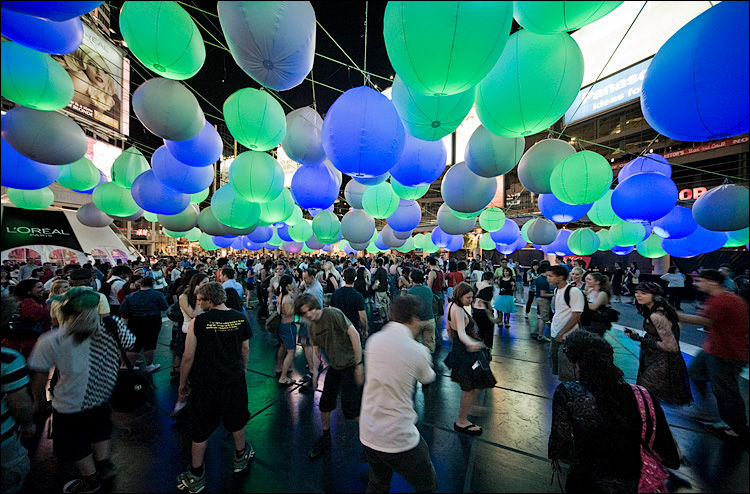
Luminato's Silent Dance Party in Toronto.

Canadians get into these things...We need some of that.

Saturday, June 7, 2008

Environmentally friendly the old fashioned way


Indeed.


We need to understand not just environmental but LOCAL. It favors a return to Carolina regionalism in our area, as Frank Harmon advocates. Folks a long time ago knew how to work with our climate and environmental resources...We need to rekindle that old wisdom and integrate it for modern life. In effect, we can have a vision for integrating the best of both eras. Now that's thinking!

Permeable Pavers (materials/construction)

This is an idea for our parking area:


ISFA installed the largest parking lot made of Unilock's permeable pavers for the US Cellular Field in Chicago. ISFA is claiming it "achieved a $400,000 cost savings compared with what it would have cost to install and maintain traditional asphalt paving...Not only does installation and maintenance of permeable pavement typically cost less than it would for poured-in-place concrete and bituminous asphalt, but it is highly durable and stronger that those materials and it lasts twice as long as traditional paving, according to an ISFA press statement." (hat tip: Philip Proefrock)


Another solution is to use an Ecogrid, which not only keeps gravel in place but helps distribute weight evenly on the parking surface. It assures filtration while preventing problems with pooling/gravel dispersement. An ecogrid can also be used for a green roof.

A less effective solution is the Eco Stone or other such pavers. It seems to me the permeability of the concrete itself is the major benefit of Unilock's paver, which will allow easy adoption by more commercial applications...and help lower landscaping costs associated with open cell systems.

Sunday, June 1, 2008

How this princess is saving the world


princess, originally uploaded by Tatiana Cardeal.


A carbon footprint study concludes that even the homeless and the most carbon efficient lifestyles in America leave a carbon footprint twice the international average.


The study concludes:


In general, spending money on travel or on goods that have substantial energy costs in their manufacture and delivery adds to a person's carbon footprint, while expenditures on locally based labor-intensive services--whether it's going to a therapist, taking an art class, or getting a massage--leads to a smaller footprint.

But the biggest factors in most people's lives were the obvious energy-users: housing, transportation and food. "The simple way you get people's carbon use down is to tax it," Gutowski says. "That's a hard pill to swallow--politicians don't like to step up" to support such measures. Absent such national actions, he says, it is important to study "what role consumer choices can play" in lowering the nation's carbon emissions.

Thomas Friedman, incidentally, recently concluded similarly...blaming Congress, so the last hope is changing consumer habits.


All this makes me wonder, can we truly make an impact if our economy fundamentally is tied to consumptive lifestyles? Steering Americans to local choices would be a start. Can we learn from Africans? David Ajaye thinks we can...Look at the energy resilient nature of African cities he points. We might try to save Africans, but maybe they can also save us. ')

Wednesday, May 28, 2008

Westbeth Thoughts


Westbeth Courtyard II, originally uploaded by R. Duke.

Thanks everyone for your input last night!

Here is a short "my take" on comments received last night for an artist-supportive development (above is the precedent of Westbeth suggested by Phillip). While the Parkwood development is not necessarily an "artist community" per se, a starting point for programming and creative development is a concept. Concepts are not pristine things you order online. They grow organically from ideas that get batted around. So let's just engage "artist community" and see where that gets us next.

Big Take:

1) honor the disciplines - sound-proof walls for music/performance, expansive floor area for dance, kiln and arable messy room for throwing clay, as examples.

2) insulate the artists from each other -- related to this: privacy; security; ability to shrink into one's oyster shell; escape; meditation; light; water; serenity; quiet; meditative space; secret escape hatch/back door access away from public areas.

3) affordability: shared living space, shared kitchen for economy units

4) artist condos: basic; adaptable; light everywhere; well-ventilated; concrete floor; "spacy"; no need to finish (except for perhaps bamboo cabinetry); will be partitioned/finished by owner

5) courtyards: one public, one for residents only - an atrium garden

6) water as a special feature

7) green roof (w/ amenities)

8) flexible common area for producing work w/ tool shop, etc

9) no need for designated ground floor "gallery space", focus on sustainable retail like coffee/deli shop and office space

Sunday, May 25, 2008

The Power of Design


A wonderful essay by KT Meaney has been posted over at Design Observer.
This piece very nicely points toward a behavioral economics approach to influencing buyer's choices (at the buying point - in supermarket aisles) with the powerful aide of design.
There's some powerful thinking here!

Friday, May 23, 2008

Everything they didn't teach me enough in college...


seastead[2], originally uploaded by bldgblog.

....I get brom BLDGBLOG:

The declarative/constitutionalizing architecture of seasteading.